

I have a bit of an Amazon.com addiction. I’m rather embarrassed to admit how much time I spend on the site, and how little impulse control I have when I’m there. Too often, I buy multiple books at once and then never read any of them. This year, I decided I would actually read (most of) the books I buy, and, to my credit, I have read a lot more (and bought a lot less) than in past years.
Since 2016 is half over, Amazon spent last week sending emails about best sellers in the first half of the year. Of course, I looked to see what made the various lists, and was surprised to see that I’ve read so many on the Business list. Not because I don’t read business books, and certainly not because I haven’t been reading, but because I didn’t think of any of these books as “business books”. I had read them in my pursuit to better understand the state of the research for what the Army calls the “Human Dimension”.
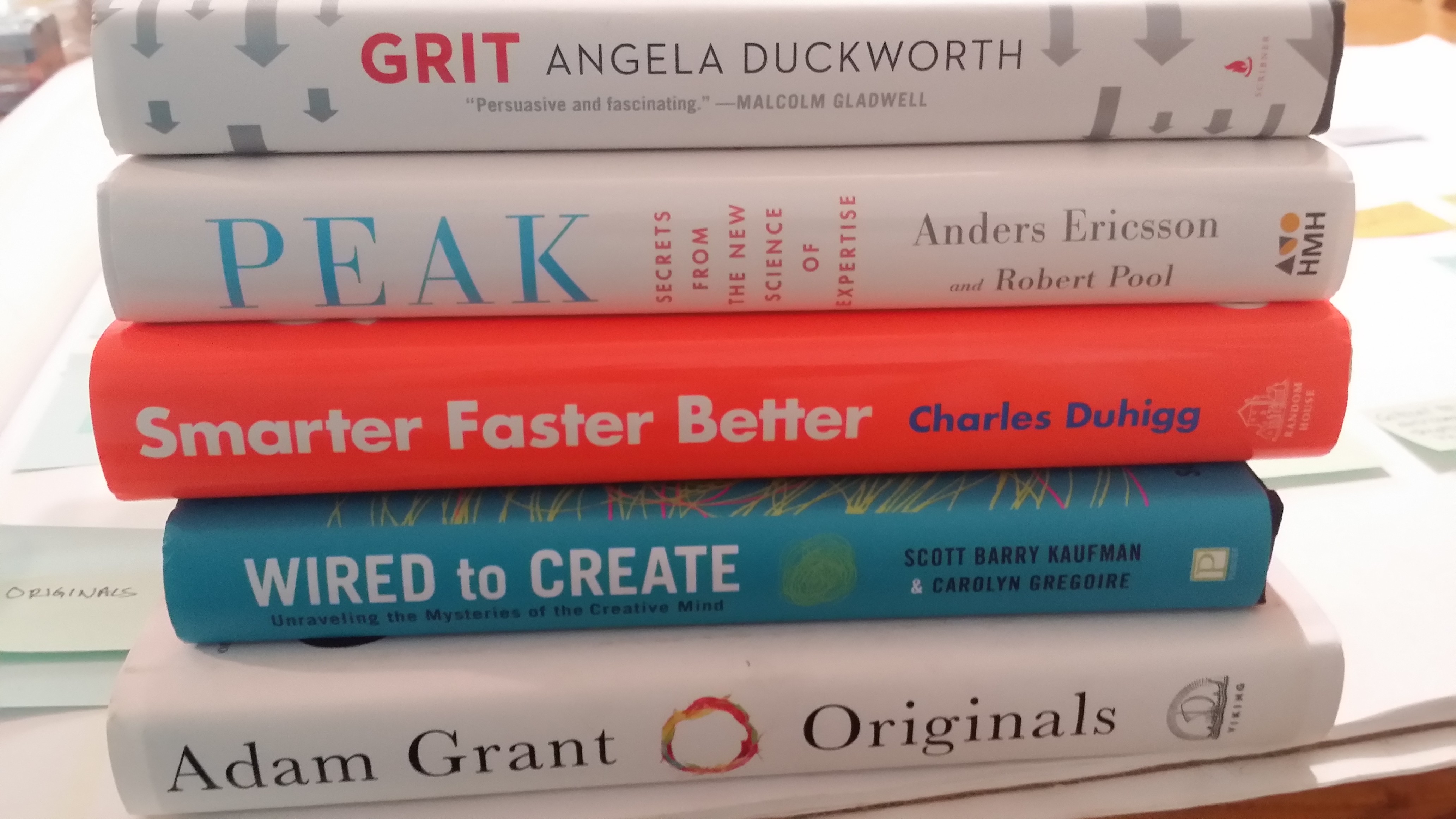
Seeing their classification, and that they are all doing so well made me start thinking about the common threads among the books. I decided to do a more structured (but still very unscientific) analysis of four of the books, with a fifth (released in December 2015) thrown in for good measure:
|  |
I summarized each chapter on to one 3”x3” Post-It Note, and then transferred the information from those, one thought at a time, to smaller ones that could be moved around, and put them all on a big piece of easel pad paper.
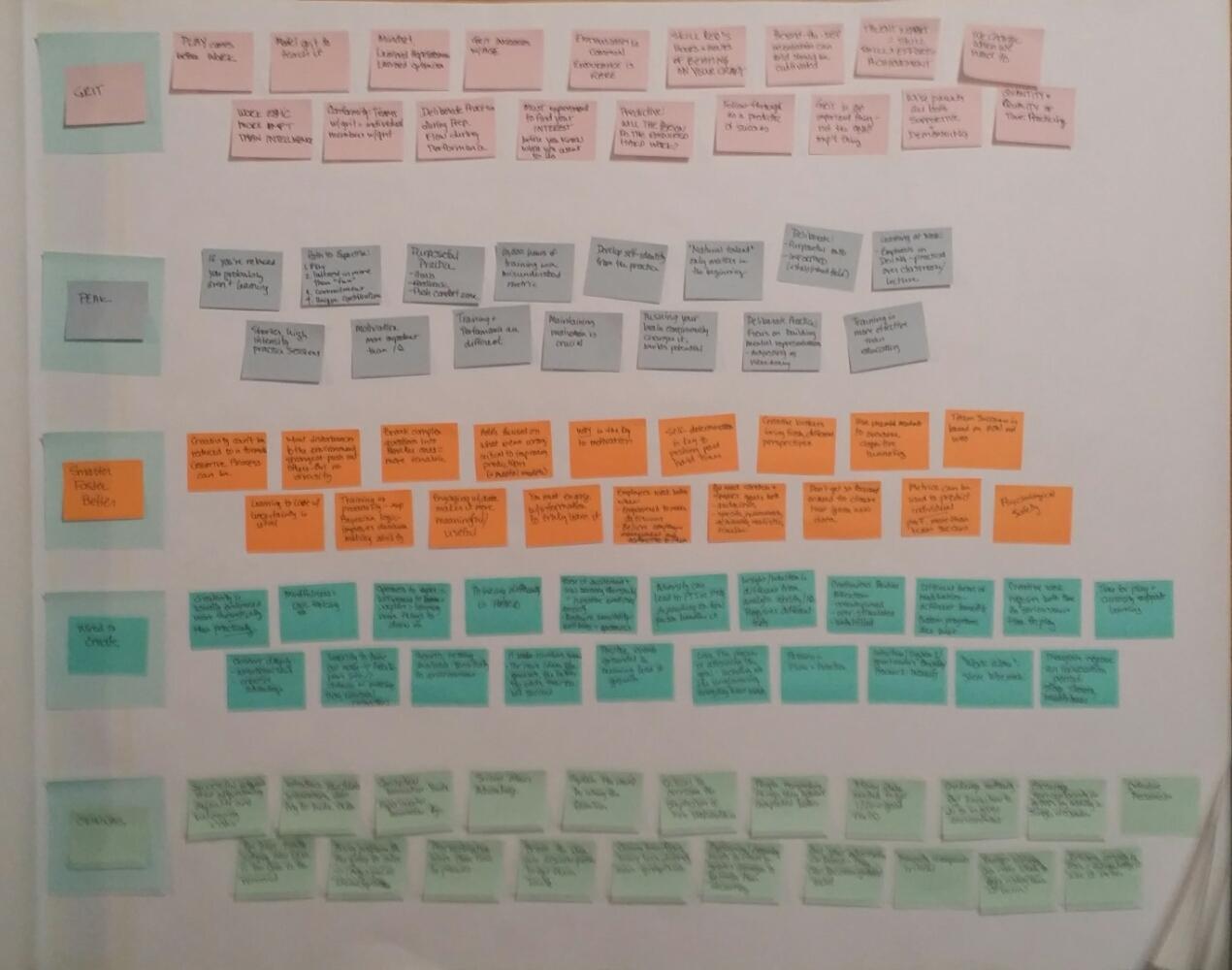
Once I moved them around, what did I find?
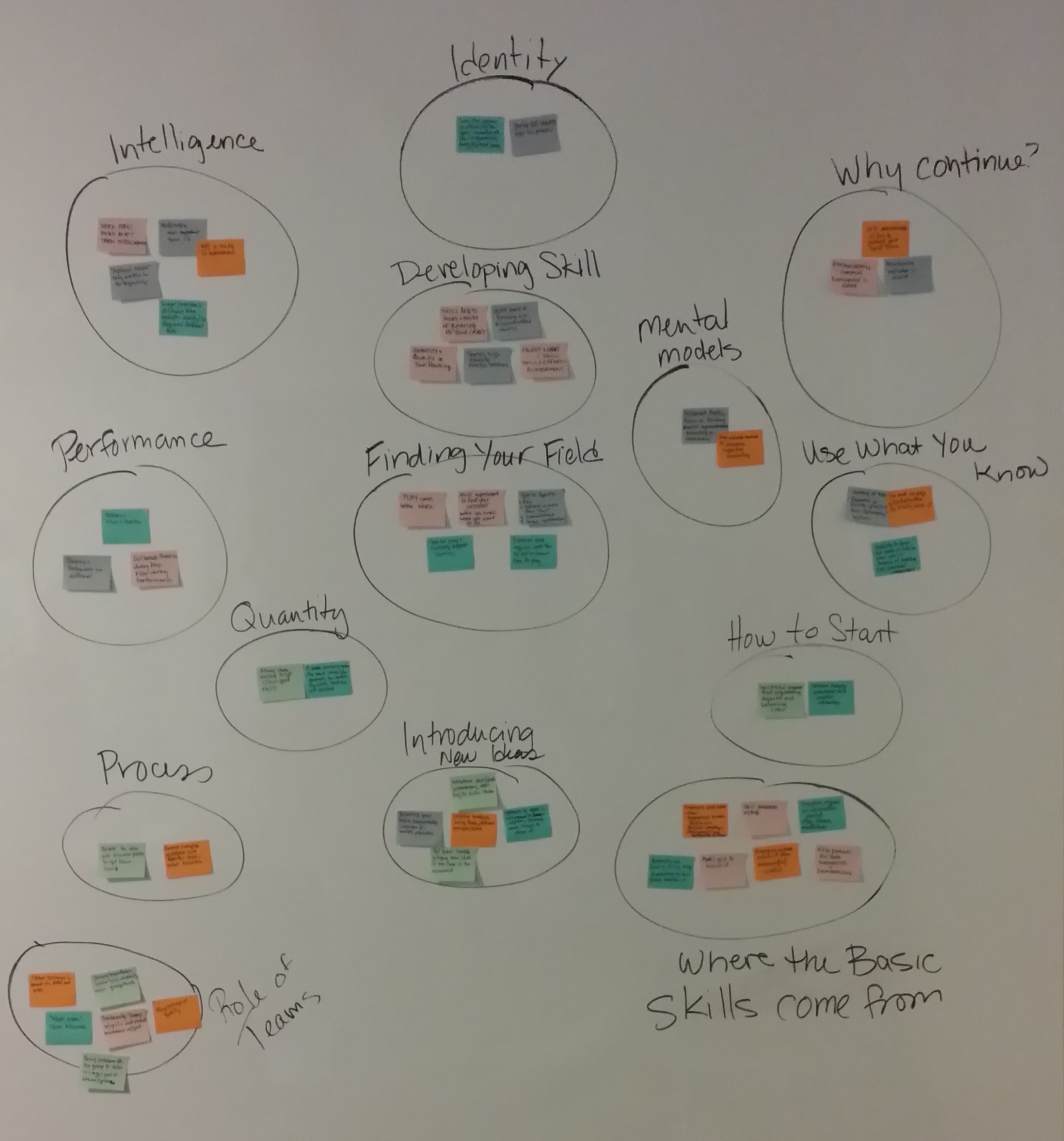 | 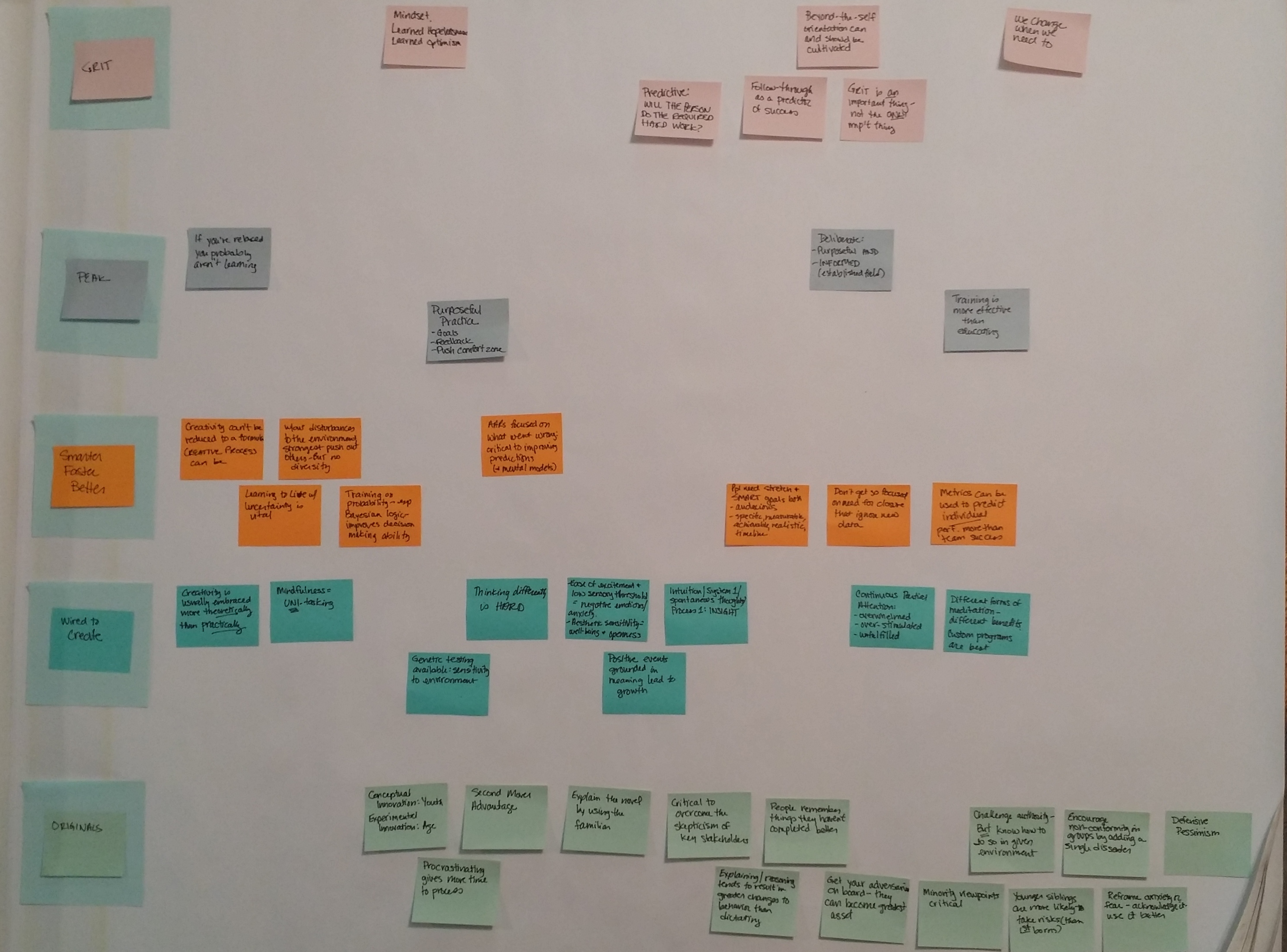 |
Well, honestly, not as much as I thought. The things that struck me as being related when I thought about the books abstractly were clearly NOT key topics of given chapters, so didn’t make it into the analysis. Perhaps if I’d tried to link them serially, I would have seen more, but just grouping wasn’t as dramatic as I expected.
But that doesn’t mean there weren’t trends.
First: Originals had the least overlap with the other four books. That doesn’t make the information better or worse, just different. Peak and Grit had the most overlap (Duckworth actually references Ericsson’s work, so that wasn’t too surprising).
Now, for the important part: the trends.
The only semi-conflicting information was on the value of commitment based organizations – those organizations that are very focused on taking care of its employees as one of its prime missions. On the one hand, they tend to be very stable, and last longer in environments like Silicon Valley, despite the fact that such values were deemed “dead” in the 1990s. On the other hand, they tend to attract like-minded people, leading to groupthink and too little ability to adapt. Dissension in the ranks can be good (as long as there is psychological safety, according to a third book).
While the trends aren’t as strong as I expected, I would say that, looking at the totality of the information in the books: training is important. (OK, that comes as no surprise to anyone who knows me.) But there is more to it, especially for the Army. Taking each trend above:
There is a lot of research being conducted in many different arenas related to the “Human Dimension”. And with the number of people in the Army organization – 1M in uniform, 330k civilian – it is, without a doubt, easier to focus on materiel development than on the human dimension. But the human element – fixing training, improving recruiting metrics, understanding why there are so many impulse control issues among returning soldiers, and so on – is significantly less expensive (means) and provides the Army a way to significantly increase the readiness (ends) in the near-term.
© 2016, Analysis First LLC