- Home
- Archive by category "Recruiting"


I have a bit of an Amazon.com addiction. I’m rather embarrassed to admit how much time I spend on the site, and how little impulse control I have when I’m there. Too often, I buy multiple books at once and then never read any of them. This year, I decided I would actually read (most of) the books I buy, and, to my credit, I have read a lot more (and bought a lot less) than in past years.
Since 2016 is half over, Amazon spent last week sending emails about best sellers in the first half of the year. Of course, I looked to see what made the various lists, and was surprised to see that I’ve read so many on the Business list. Not because I don’t read business books, and certainly not because I haven’t been reading, but because I didn’t think of any of these books as “business books”. I had read them in my pursuit to better understand the state of the research for what the Army calls the “Human Dimension”.
Seeing their classification, and that they are all doing so well made me start thinking about the common threads among the books. I decided to do a more structured (but still very unscientific) analysis of four of the books, with a fifth (released in December 2015) thrown in for good measure:
|  |
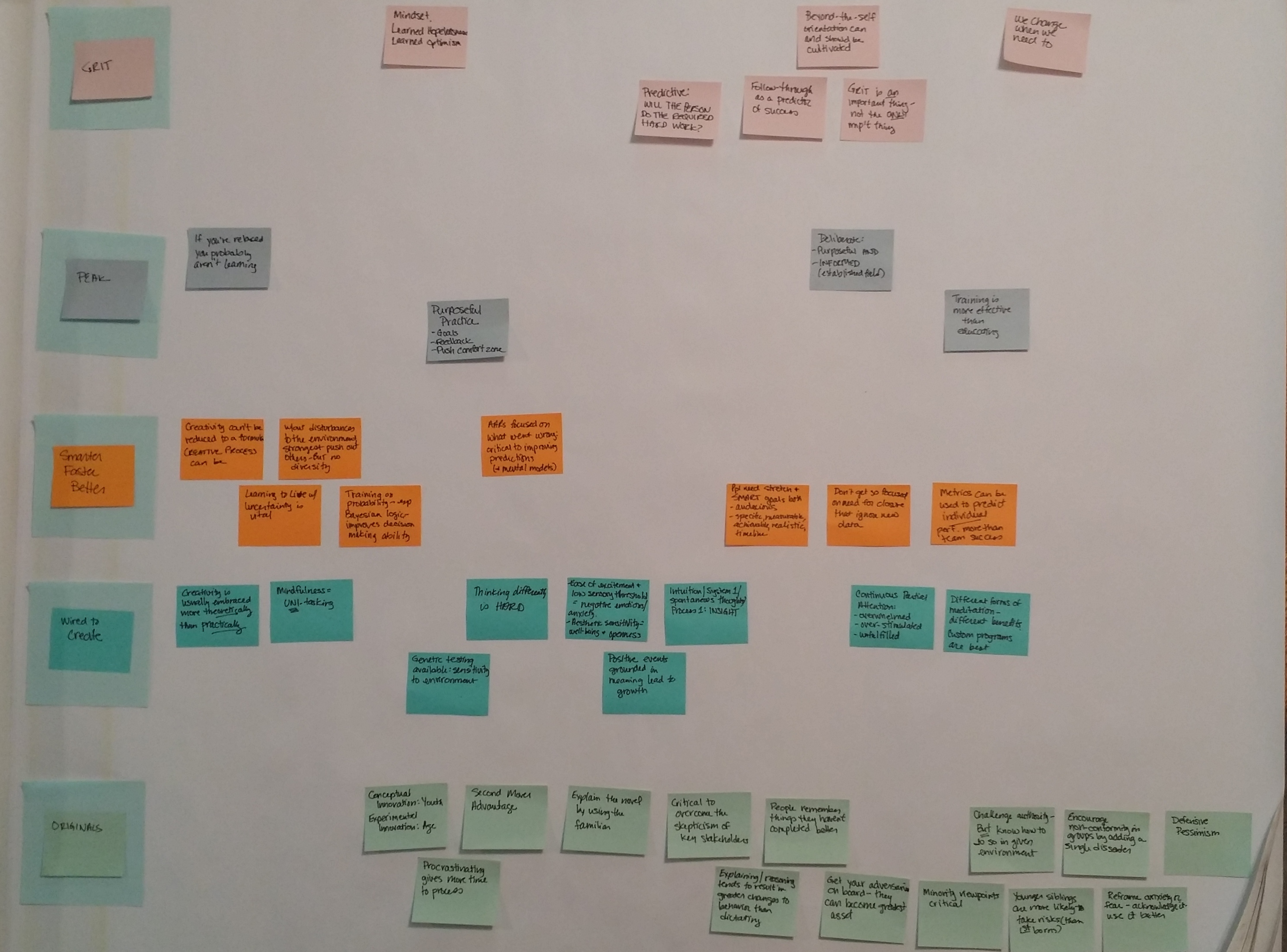
I summarized each chapter on to one 3”x3” Post-It Note, and then transferred the information from those, one thought at a time, to smaller ones that could be moved around, and put them all on a big piece of easel pad paper.
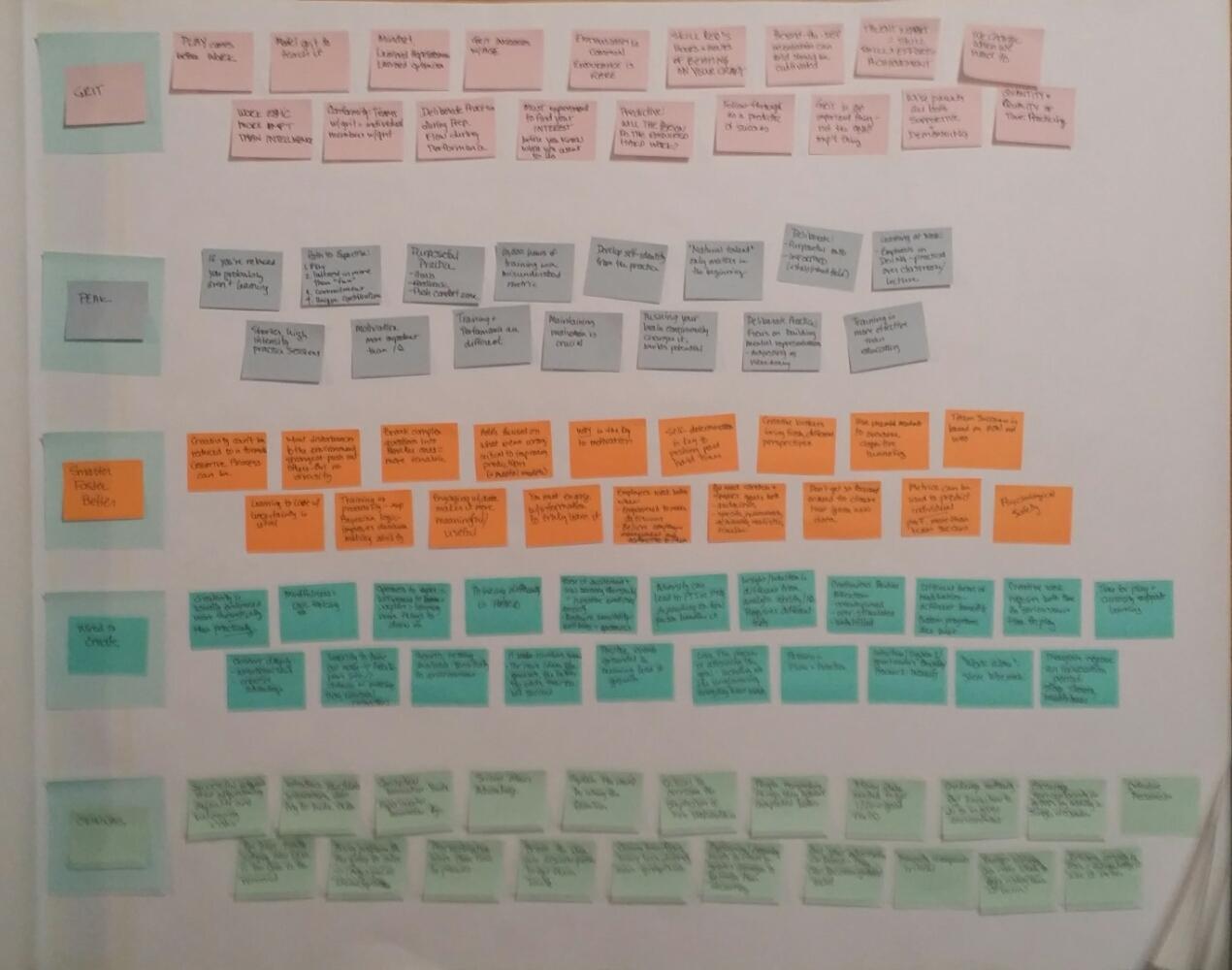
Once I moved them around, what did I find?
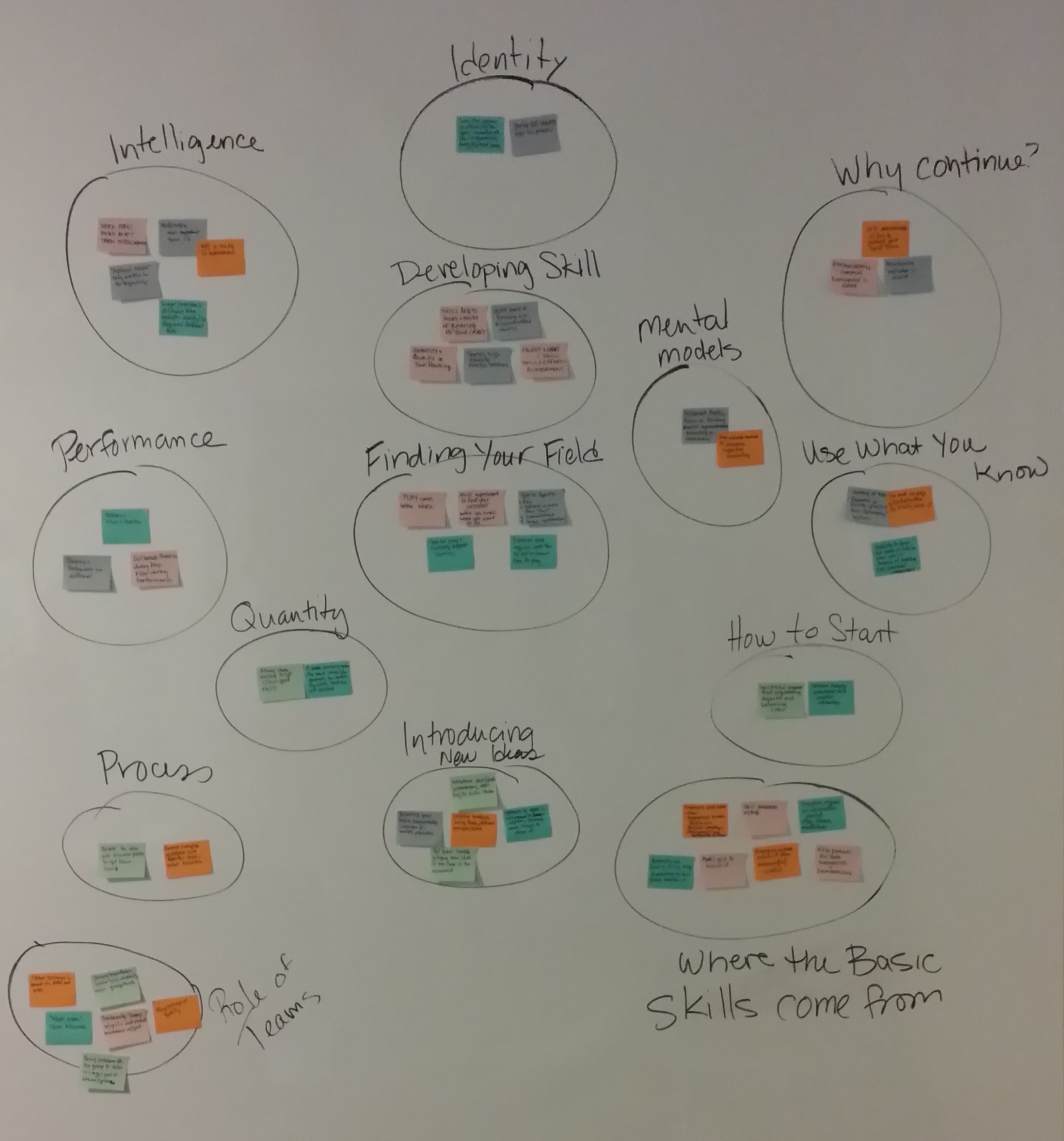 |  |
Well, honestly, not as much as I thought. The things that struck me as being related when I thought about the books abstractly were clearly NOT key topics of given chapters, so didn’t make it into the analysis. Perhaps if I’d tried to link them serially, I would have seen more, but just grouping wasn’t as dramatic as I expected.
But that doesn’t mean there weren’t trends.
First: Originals had the least overlap with the other four books. That doesn’t make the information better or worse, just different. Peak and Grit had the most overlap (Duckworth actually references Ericsson’s work, so that wasn’t too surprising).
Now, for the important part: the trends.
The only semi-conflicting information was on the value of commitment based organizations – those organizations that are very focused on taking care of its employees as one of its prime missions. On the one hand, they tend to be very stable, and last longer in environments like Silicon Valley, despite the fact that such values were deemed “dead” in the 1990s. On the other hand, they tend to attract like-minded people, leading to groupthink and too little ability to adapt. Dissension in the ranks can be good (as long as there is psychological safety, according to a third book).
While the trends aren’t as strong as I expected, I would say that, looking at the totality of the information in the books: training is important. (OK, that comes as no surprise to anyone who knows me.) But there is more to it, especially for the Army. Taking each trend above:
There is a lot of research being conducted in many different arenas related to the “Human Dimension”. And with the number of people in the Army organization – 1M in uniform, 330k civilian – it is, without a doubt, easier to focus on materiel development than on the human dimension. But the human element – fixing training, improving recruiting metrics, understanding why there are so many impulse control issues among returning soldiers, and so on – is significantly less expensive (means) and provides the Army a way to significantly increase the readiness (ends) in the near-term.
This week, I had the opportunity to attend an Army human dimension workshop. We spent two days discussing what some groups are doing to improve human performance today; what the future of war might look like; and discussing, in breakout groups, the soldier of 2050, what s/he will look like, and what it will take to recruit that soldier.
Part of the discussion in my group included the following points: that a lot of the work will be done by robots (whether a true robot or some other use of automation), not soldiers, allowing us to reduce the number of soldiers needed – or, perhaps, simply changing how they are distributed; that the brain’s of children and young adults today look different than they did 20 years ago, due to changes in school curricula (reducing the amount of memorizing required, reducing the amount of time spent in physical activity) and lifestyle (no need to memorize, for instance, a phone number, if you have it saved in your phone); and that distance education and virtual reality are likely to play an increasing role in education at all levels, effecting interpersonal skills.
But the more I thought about these assumptions, the more they bothered me.
We are talking about soldiers who, for the most part, have not yet been born. The enlistee of 2050 will not be born for another 15 years; the Army Chief of Staff of 2050 may be a student in the Basic Officer Leadership Course today. There is a lot of time between now and then to effect change if we, as an Army and/or as a country, want things to change.
Rather than accepting these assumptions, it seems to me that we should, yes, consider trends in warfighting technology, but also in education and other relevant areas, and determine which trends we want to effect. And then take the next 35 years doing so.
For example: children today spend less time outside being physical today than they did 30 years ago. That trend is expected to continue. Besides basic physical fitness, exercise, especially outside, results in increased bone density, both from the activity and from being in the sun, absorbing vitamin D. The downward trend of exercise (and drinking milk, another major source of vitamin D), is already effecting recruiting, as demonstrated by increased obesity, bone breakages in boot camp, etc. By 2050, this problem is expected to be significantly worse, increasing the difficulty in recruiting healthy soldiers; this problem will cross the other services and also first responders of all types. What can be done to reverse that? For example, can the Army work through the Executive Branch directly to develop programs in the Department of Education to emphasize physical education in school? Does Congress need to be involved either directing the work, or funding it?
When we talk about recruiting in 2050, we are talking about individuals who are post-Generation Z.* Sociologists still don’t have a full grasp of Gen Z characteristics – in part because they are still teenagers and younger. Though we can make assumptions, based on past generations and future trends, as to what the future recruit will look like, don’t even have a name yet for the generation we’re discussing. So, rather than assume our hands tied by what might be, how can we, as the human dimension community, can help ensure we have the recruits we need? Ultimately, because the Army thinks about the future in a way most industry does not, we are in a position to help the country as a whole be healthier 30 years from now because we are thinking about these things.
The Army used to be a leader in technology. We’ve lost a lot of that edge. Because of the rate that companies can work in the private sector now, undeterred by layers of bureaucracy, we are unlikely to regain that leadership position. But the Army can take the reigns in working toward a healthier US population. Now, wouldn’t that be something.
* Generation Z refers approximately to individuals born in the 2000s-2020.
Generation Y/Millenials are generally those born between 1980-1999.
Generation X are those born post-Baby Boom, pre-Millenial: 1965-1979.
Baby Boomers are those born between 1946-1964.
This week, New America hosted a forum entitled “The Future of War”. The speakers included the Service Chiefs from the Army, Marine Corps, and Navy, and the Air Force’s Vice Chief was on one of the panels. Add in panels representing academia, media, technology, and retired flag officers who aren’t afraid to speak their minds, and some short discussions about human enhancement and cyber (cyber rifle, anyone?), and it was an impressive, thought-provoking line up.
GEN Milley, in a conversation with Barbara Starr, talked a lot about acquisition and the (desperate, IMO,) need for acquisition reform. Many of his comments centered around the acquisition of a new pistol: a proven technology that is readily available at Cabelas. After many years, and hundred of pages (just in the requirements document – the rest of the documents would easily get the page count into the thousands, I’m sure), the top contenders are now undergoing a two-year, $16M test. To say the approach is slow would be an understatement, and GEN Milley does not even try to hide his frustration about that.
Presumably because the acquisition is so slow, and he knows what is in the pipeline, GEN Milley mentioned that he does not see any fundamental changes coming to the Army for the next 5-10 years. Beyond that, yes, but not in the next 5-10 years.
I have a number of concerns about this, as should anyone reading this. First, our primary adversaries (Russia and China) have not spent the past 15 years at war; while we have been depleting ours, they have spent that time beefing up their own arsenals.
But more importantly, to me, is that it assumes that fundamental change can only come through materiel. What about the human dimension? It is significantly faster and less expensive (though also significantly harder, due to necessary culture changes) to strengthen the human capital of the Army – the soldiers – both physically and mentally than it is to buy a new piece of gear.
Simply focusing on the Performance Triad in a meaningful way – making sure all soldiers get sufficient amounts and quality of sleep; good, healthy, nutritious food; and daily exercise – will increase readiness, reduce injuries, and increase performance. Eight solid hours of sleep at night. Eating right. Exercising daily – preferably in the afternoon, as that has been shown to increase the likelihood that soldiers will get the sleep they need in the morning. At no added cost to the Army. Going farther, there are techniques to improve training – physical and mental – thereby improving the capabilities of each soldier. Add in more physical monitoring – which many soldiers do on their own anyway – whether through a FitBit or any of the other commercial applications, and Army leadership can be proactive in maintaining the health and readiness of the force.
Near-term improvements – even fundamental changes – are possible, and will result in a stronger, more prepared Army. But they require changes to the Army’s culture.
On second thought, acquisition reform might be easier.
Every year I try to go to at least one totally new meeting. One where I am unlikely to see another Beltway Bandit. One not run by AUSA, or NDIA, or the Army itself.
In 2013, one of those meetings was the first conference held by the Defense Entrepreneurs Forum (DEF) in Chicago. DEF is the brainchild of some then-junior officers, representing all 4 services, who were frustrated by the lack of innovation in their organizations. They came together to brainstorm ideas to different Big Problems. From a single weekend-long event, DEF has expanded to include an active social media presence, day long conferences in different locations called DEF[x]s, and recurring (often monthly) local meetings called DEF Agoras, in addition to our annual (fall) national meeting.
This past weekend was the DEF[x]William & Mary. Held at the Mason School of Business, about 80 people – a combination of military (no uniforms allowed), industry, and students – spent the day taking on some Big Problems. The topic of the day was the Third Offset, but with breakout sessions on Force of the Future, the Human Offset, and Civilian Perspectives as options, and Ori Brafman as a keynote speaker, I was looking forward to a day of thinking about the Human Dimension.
Ori started the day as you would expect him to (if you’ve ever heard him speak to a military audience, anyway). There was a lot about the Spider and the Starfish, and resilient organizations. But then he started talking about the military-civilian divide. Now, that’s not an unusual topic, but it did set the tone, at least for me, for the rest of the day.
In Force of the Future, we wound up in break out groups. Each group formed to discuss military recruiting. My group – consisting of 4 active duty officers, 2 students, and myself – focused on college students with STEM degrees. Our task was to develop a profile of what a typical person of this description would look like, so we could figure out how to recruit that person. (Two other groups were talking about retaining drone pilots and mid-career accessions of in-demand specialties like cyber.)
We named our recruit Jill Stephanopoulos – mostly to make everyone write the name “Stephanopoulos”. She’s 20 years old, from Virginia, and a mechanical engineering student at W&M (as it turns out, W&M does not have a mechanical engineering department). Why would Jill want to join the military when she had so many other options?
At this point, the group turned to our two college student members. Why would YOU join the Army? Well, the answer was: they wouldn’t.
This was a little shocking to the usually-uniformed members of our group.
But not to me. I’ve had this conversation too many times in the past year to find it at all surprising.
Less than 1% of the US population serves in the military. Less than 7% of the US population has ever served in the military – and that includes veterans from the draft era. What most people in this country know about the military is what they see on television and in movies. Between Wounded Warrior commercials (IMO, possibly the worst thing for the military recruiting top talent); news stories about PTSD, TBI, homelessness among veterans, and the issues with the Veterans Administration; and movies and television shows including all-too-regular stories about soldiers suffering from PTSD, the average American does not have a favorable impression of the military. Not because of the military itself, but because of the results of serving. They just don’t hear – and therefore don’t know – the positive stories.
Both student members of the group agreed that this is, in fact, a big part of their impression.
No wonder it’s difficult to recruit. Not only does the military pay less than engineering firms, for example, but choosing the military, in their minds, is choosing psychological or neurological damage (or both). And not being able to get help. Not a lot of 22 year olds are going to sign up for that, not when they have so many other options.
This discussion continued at lunch, though with a different group – a DoD civilian, an Army officer who is currently in school full time, an Army general officer, two different students (one majoring in Arabic, the other minoring it), and myself.
Until yesterday, the two students didn’t know you could go into the Army and not start in the infantry or armor. They knew about Defense Language Institute, but thought you had to go into the Army and “do Army stuff” first. What changed?
They met actual members of the military and had conversations with them. They heard about the wide variety of jobs the different individuals had. They learned that the military is more than uniforms, and saluting, and guns, and violence. They experienced the passion. They witnessed the pride for the job. And, yes, they also heard the frustrations, but tempered with an understanding that we all choose to continue to do this work. Because of that passion and pride.
The military wants the top students. To get them, they have to acknowledge the civilian-military divide, they have to fix the public impression of the military, and they have to educate civilians on what it really means to be in the military. This requires regular interaction with the public – not just public affairs officers, and not going where contractors will be. It means going out and talking with students – not just to recruit them. It means having actual conversations and exchange of ideas. It will not be easy. And it won’t always seem like ‘the juice is worth the squeeze’.
But recruiting the best not only means being the best, it means making sure everyone else knows you’re the best.
Next week’s post with either be about Data Analytics, Google, Amazon, and Army Recruiting or USMC Force Development 25.
Coming in May 2016: DEF[x]DC, hosted at Georgetown University.
© 2016, Analysis First LLC