- Home
- Archive by category "Readiness"


I have a bit of an Amazon.com addiction. I’m rather embarrassed to admit how much time I spend on the site, and how little impulse control I have when I’m there. Too often, I buy multiple books at once and then never read any of them. This year, I decided I would actually read (most of) the books I buy, and, to my credit, I have read a lot more (and bought a lot less) than in past years.
Since 2016 is half over, Amazon spent last week sending emails about best sellers in the first half of the year. Of course, I looked to see what made the various lists, and was surprised to see that I’ve read so many on the Business list. Not because I don’t read business books, and certainly not because I haven’t been reading, but because I didn’t think of any of these books as “business books”. I had read them in my pursuit to better understand the state of the research for what the Army calls the “Human Dimension”.
Seeing their classification, and that they are all doing so well made me start thinking about the common threads among the books. I decided to do a more structured (but still very unscientific) analysis of four of the books, with a fifth (released in December 2015) thrown in for good measure:
|  |
I summarized each chapter on to one 3”x3” Post-It Note, and then transferred the information from those, one thought at a time, to smaller ones that could be moved around, and put them all on a big piece of easel pad paper.
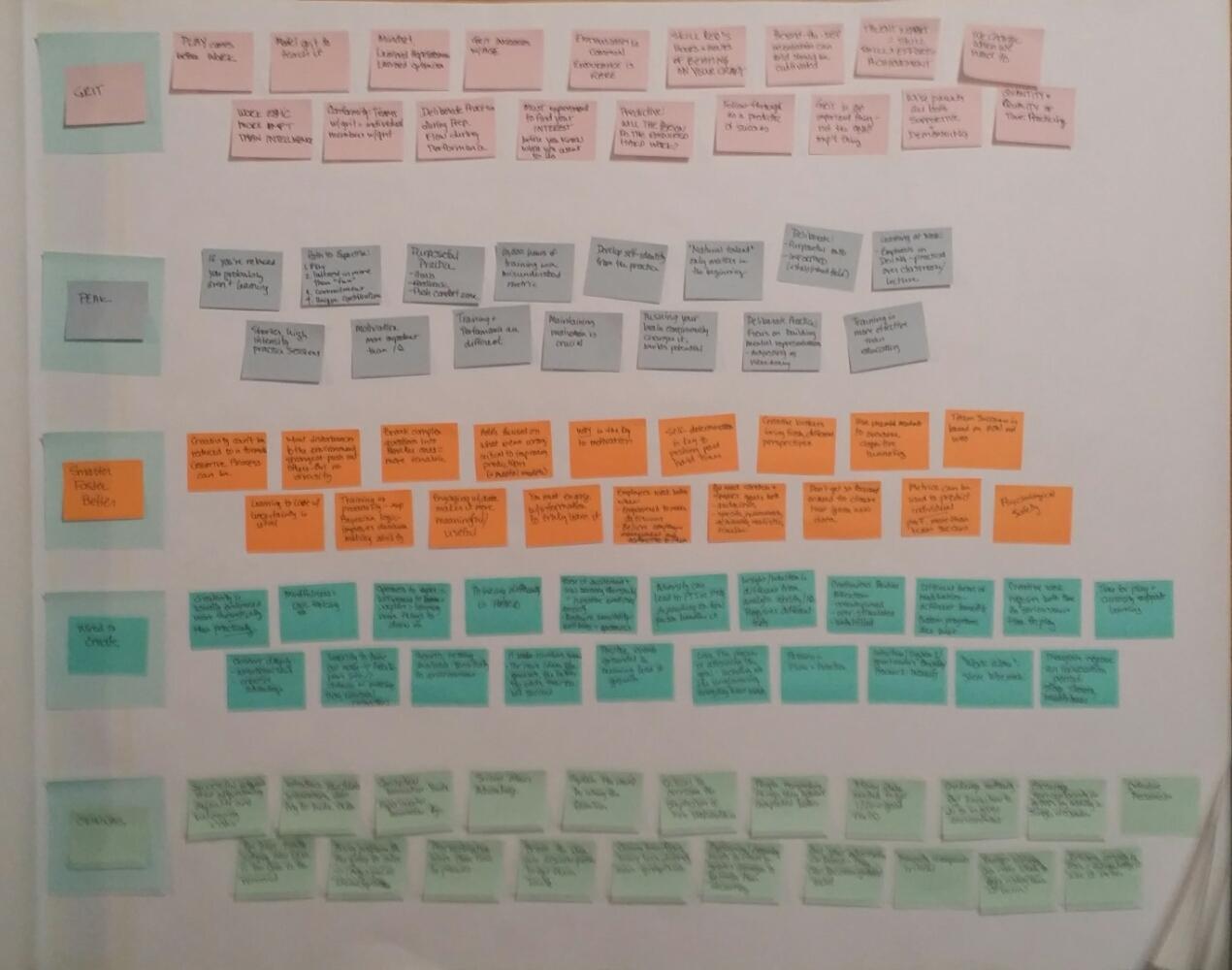
Once I moved them around, what did I find?
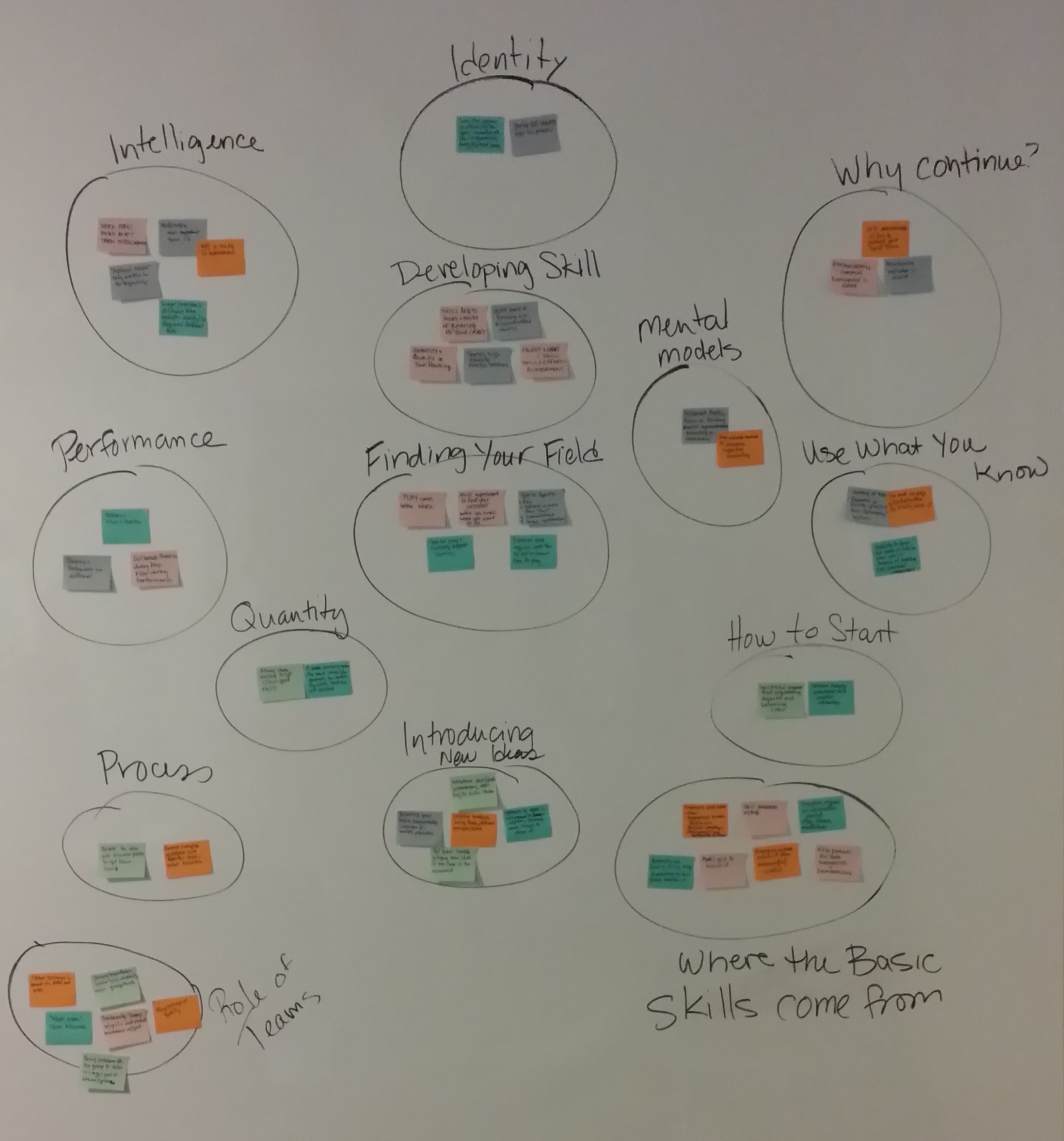 |  |
Well, honestly, not as much as I thought. The things that struck me as being related when I thought about the books abstractly were clearly NOT key topics of given chapters, so didn’t make it into the analysis. Perhaps if I’d tried to link them serially, I would have seen more, but just grouping wasn’t as dramatic as I expected.
But that doesn’t mean there weren’t trends.
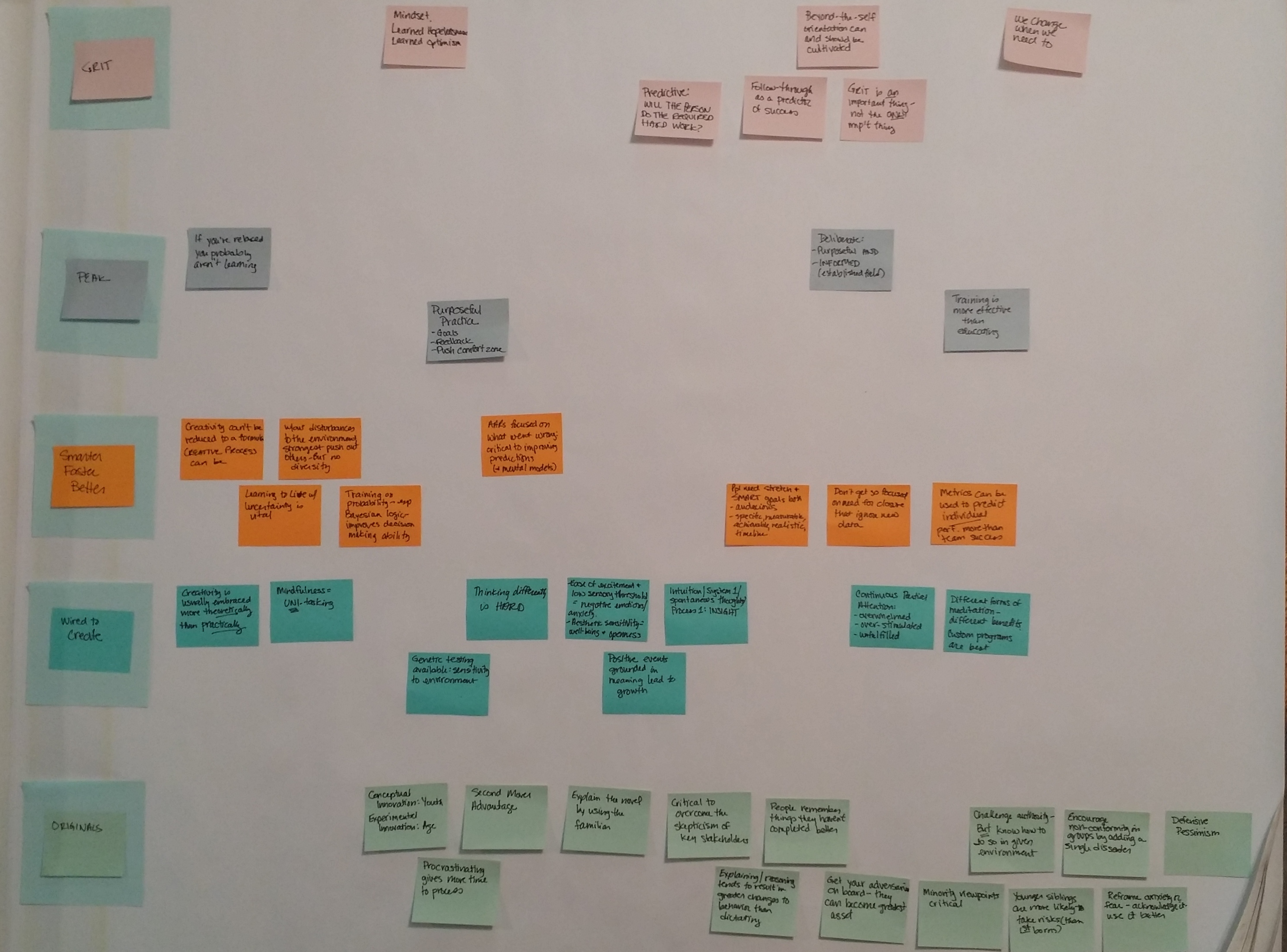
First: Originals had the least overlap with the other four books. That doesn’t make the information better or worse, just different. Peak and Grit had the most overlap (Duckworth actually references Ericsson’s work, so that wasn’t too surprising).
Now, for the important part: the trends.
The only semi-conflicting information was on the value of commitment based organizations – those organizations that are very focused on taking care of its employees as one of its prime missions. On the one hand, they tend to be very stable, and last longer in environments like Silicon Valley, despite the fact that such values were deemed “dead” in the 1990s. On the other hand, they tend to attract like-minded people, leading to groupthink and too little ability to adapt. Dissension in the ranks can be good (as long as there is psychological safety, according to a third book).
While the trends aren’t as strong as I expected, I would say that, looking at the totality of the information in the books: training is important. (OK, that comes as no surprise to anyone who knows me.) But there is more to it, especially for the Army. Taking each trend above:
There is a lot of research being conducted in many different arenas related to the “Human Dimension”. And with the number of people in the Army organization – 1M in uniform, 330k civilian – it is, without a doubt, easier to focus on materiel development than on the human dimension. But the human element – fixing training, improving recruiting metrics, understanding why there are so many impulse control issues among returning soldiers, and so on – is significantly less expensive (means) and provides the Army a way to significantly increase the readiness (ends) in the near-term.
First, I need to acknowledge something: this whole “remembering to blog weekly thing” is harder (for me) than it should be. So, no more scheduling. Of any kind. Though I will (probably) go back in and fill in some holes. Especially about Peak, a book that is somewhat relevant to today’s post (at least in my mind), but I still haven’t managed to put together my thoughts in a sufficiently coherent manner, so I’m not ready to push “publish” on last week’s post quite yet.
For a number of reasons, this year, I haven’t been able to travel the way I have in years past. So instead, I’m going to events at various DC think tanks. It’s that, or I never leave my house. As an introvert, I’m pretty comfortable with that, but it’s not healthy, so… think tank events it is. Last week’s was “Army Readiness, Fight tonight and Fit for Tomorrow” at the Center for New American Studies. The speakers were Mr. Daniel Feehan, Principal Deputy Assistant Secretary of Defense (Readiness); MG Walter E. Piatt, Director of Operations, Readiness and Mobilization, Army G3/5/7; Mr. Andrew Hill, U.S. Army War College; and Ms. Katherine Kidder, Center for a New American Security.
Readiness is GEN Milley’s top priority and, as he says “there is no other number 1”. Readiness is the ability to defeat one peer competitor while holding back a second without losing ground in the war on terror. That’s a lot to expect from an Army that has 14 years of continuous asymmetric warfare under its belt; no full spectrum operations in that time (and very little training for it); and soldiers who are tired from the continuous cycle of deployments. rip
Readiness is usually seen as a tri-pod; manning, equipping, and training must balance for the organization to be ready. For the Army, manning levels are set by someone else. (Though there is a lot the Army can do to effect its manning by having the right people – recruitment and retention – that’s not today’s topic.) Equipping? Soldiers have a lot of good equipment – thanks to 14 years of warfare – and what they don’t have now, they won’t have any time soon, based on development timelines. (In fact, in February at New America’s Future of War Conference – I told you, I’m going to a lot of think tank events – GEN Milley said he doesn’t see any major new systems coming, just upgrades to legacy materiel, for the next 5-10 years.) So the key to improving readiness, it seems to me, is training.
Training systems – whether live, virtual, or constructive – are expensive and cumbersome. They all introduce various levels of non-realism. And all are limited, either by the number of people who can use them at once, by the echelon that is going to get priority, or by the terrain they cover. Many are ‘better than nothing’ – but often, the juice (cost and what it takes to make them work) isn’t worth the squeeze (the learning achieved). And our soldiers (and taxpayers) deserve better than this. And readiness demands it. Time at CTC, the premiere training event, has been shown to be more effective for organizations that have had more pre-CTC homestation training. So how do we get more out there?
Complaints about the current training systems are plentiful.
Live training (e.g., MILES)
Virtual training (e.g., DSTS)
Constructive training
None of these concerns are new or unknown to the Army. PEO STRI is working to field new systems, but the process is so slow that it will be 2025 before there is a new individual MILES system fielded, and 2028 before an integrated live, virtual, constructive, and gaming system is fielded.
But what about the next 10 years? What about readiness now? How do we increase full-spectrum operations training?
I’ve spent almost a decade working this issue. It can actually be resolved fairly easily, but there’s actually no path through the system for an easy training system. That being said, here are my observations:
Most organizations – governmental (PEO STRI and the USMC both have MILES issues, and both are looking at them the same way) and other companies – look at the issues with MILES as primarily an issue with the interrogator. If the laser could penetrate better, the system would work better. To that end, they’ve considered other wavelengths (1550 nm vs the current 908 nm), other technologies (e.g., geopairing), etc, for the next generation systems – and wind up back with the old system (partly because of backwards compatibility issues that STRI can’t seem to break free from).
When we first started designing TIS, the Training and Identification System, we didn’t focus on components. We looked at SYSTEM requirements. Because of that, we have a very different solution. Rather than fixing the issues at the interrogator end, we were free to look at the whole issue. And that’s what we did. By making one addition to the MILES communication code and adding a COTS smartphone (in place of any other kind of radio) on the target, we can resolve three of the four complaints about MILES. (Details to follow in a subsequent post – or contact me for details.)
But we didn’t stop there.
Because we know that the long-term goal is to incorporate live training with virtual, constructive, and gaming technologies, we wanted to make sure that TIS could do that. So we incorporated plans for alternative means of firing the laser (current MILES technology “fires” off the force of the blank leaving the barrel – this could be very dangerous in an LVCG environment where the shooter may be facing something or someone other than what he is seeing), designs for incorporating the shot into the virtual world, and so on – again, using a COTS smartphone as one of the major components.
Training can be modernized – training MUST BE modernized in a much shorter timeline – to improve readiness. Homestation training can be available without expensive instrumentation (that requires environmental assessments and approvals), to multiple groups, without need for a lot of extra space or people to run the systems. Guard units can actually make full use of their 48 Unit Training Assemblies and at 15 days of Annual Training rather than spending most of the time trying to get the gear to work (if they can use it at their armories at all).
Realistic, affordable, useable training systems in the hands of soldiers is the key to increasing readiness. But it requires a means other than the traditional process, or it will be late into the next decade before soldiers have it.
When we first started Analysis First, our focus was on a materiel training solution. After all, that’s where the money is. Also, when you have a fantastic idea, that will be the best thing the Army has ever seen, and soldiers will DEMAND to have in their kit, how could you not?
Well, let’s just say that was a long and expensive lesson in how the Army acquisition system does and does not work.
(And in case you think I’m exaggerating about the product’s usefulness, in one meeting with a uniformed S&T officer, my initial emails were compared with “those Nigerian email scams” because it was just too good to be true.)
In spite of the system never going anywhere, my passion for well trained soldiers continues. I’m not talking about the hours and hours of mandatory “You’re in the Army Now” training that everyone takes to check the box(es). I’m talking about actual job training: working towards an ability to dominate any adversary, whatever your job is.
I’m sure I will talk more about TIS in the future, but for today, I’ll just put out a few things that I think are vital to a new training system.
On Demand Training: Any organization should be able to train at any time, anywhwere. Yes, large scale operations take a lot planning, but a platoon leader should be able to make a decision to train and be able to implement quickly. Very few locations have homestation training available.
Scalable Training: Not only should any organization be able to train, but the same systems should be scalable. Training a squad and training a brigade should not look substantially different, insofar as the individual soldier and his tasks are concerned.
Easy to Use: It should not take a cadre of contractors to run and maintain the training systems. They should be intuitive to use, and easy to maintain.
And last, but certainly not least…
Realistic: We can’t replicate everything about war, but we certainly should come as close as we can. You can’t stop a bullet by covering yourself in dirt, so you shouldn’t be able to avoid being “injured” in training by doing so. “Train as you fight” has been a mantra for a long time. The technology exists. It’s time our soldiers had it.
© 2016, Analysis First LLC