- Home
- Archive by category "Training"


I have a bit of an Amazon.com addiction. I’m rather embarrassed to admit how much time I spend on the site, and how little impulse control I have when I’m there. Too often, I buy multiple books at once and then never read any of them. This year, I decided I would actually read (most of) the books I buy, and, to my credit, I have read a lot more (and bought a lot less) than in past years.
Since 2016 is half over, Amazon spent last week sending emails about best sellers in the first half of the year. Of course, I looked to see what made the various lists, and was surprised to see that I’ve read so many on the Business list. Not because I don’t read business books, and certainly not because I haven’t been reading, but because I didn’t think of any of these books as “business books”. I had read them in my pursuit to better understand the state of the research for what the Army calls the “Human Dimension”.
Seeing their classification, and that they are all doing so well made me start thinking about the common threads among the books. I decided to do a more structured (but still very unscientific) analysis of four of the books, with a fifth (released in December 2015) thrown in for good measure:
|  |
I summarized each chapter on to one 3”x3” Post-It Note, and then transferred the information from those, one thought at a time, to smaller ones that could be moved around, and put them all on a big piece of easel pad paper.
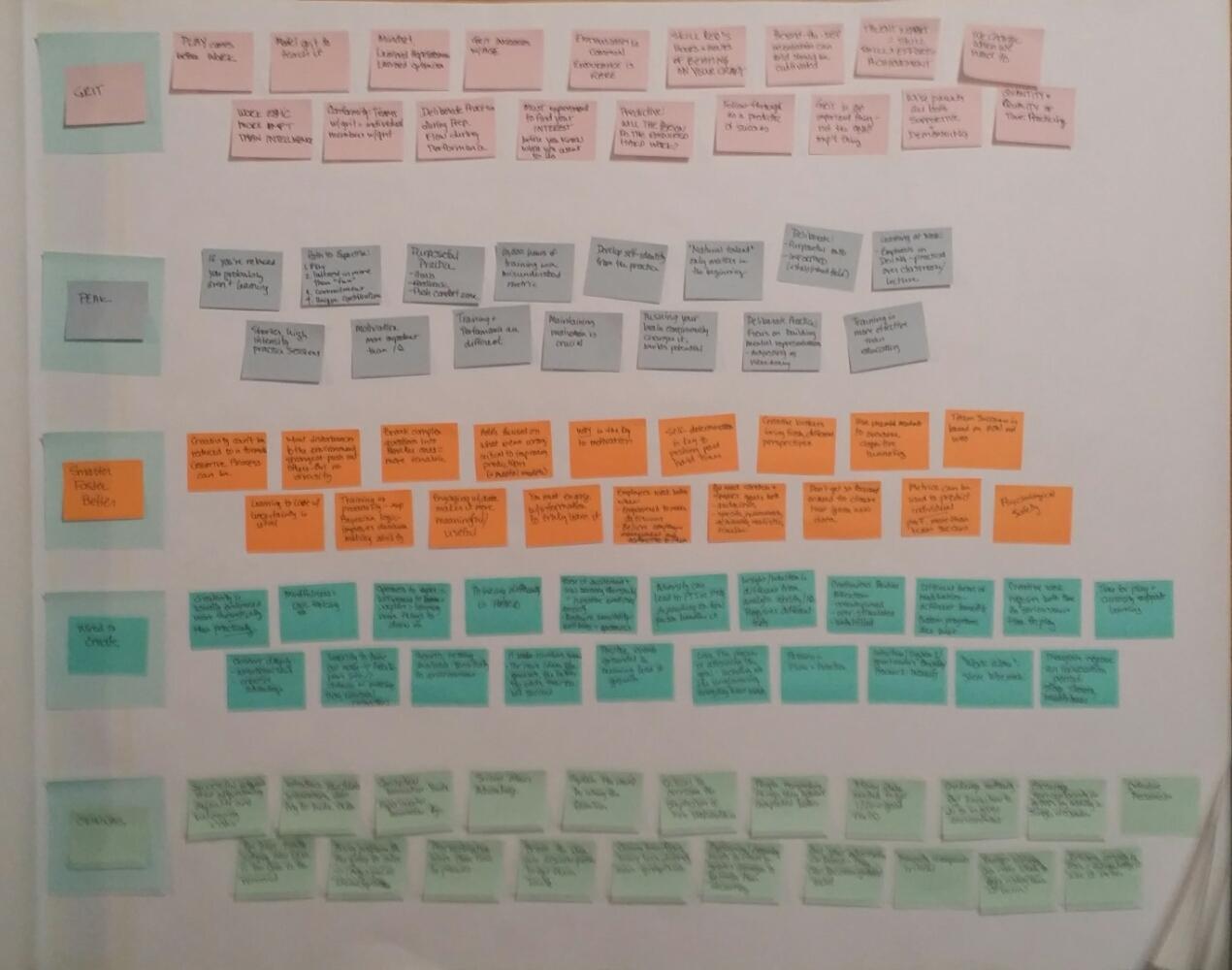
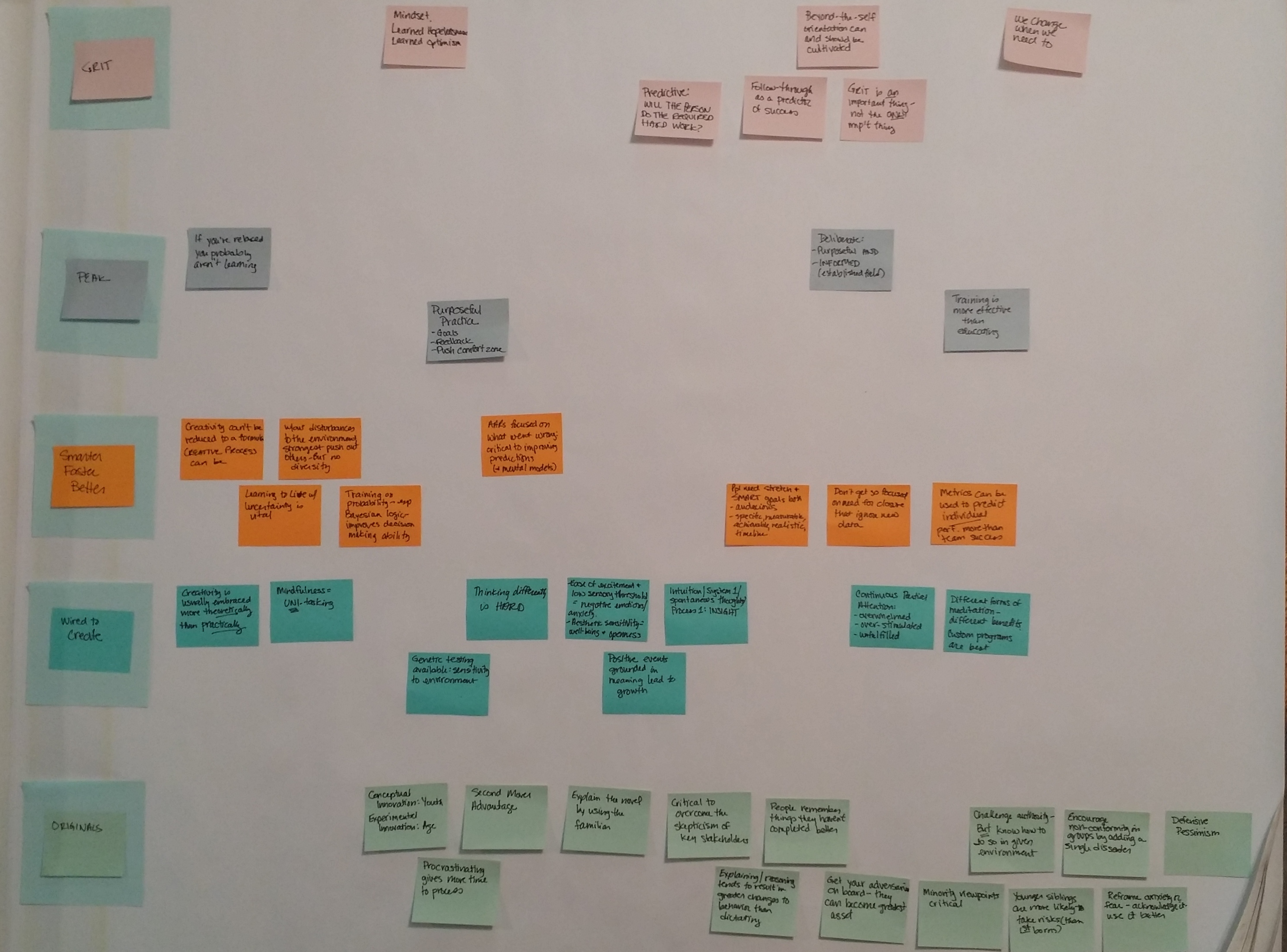
Once I moved them around, what did I find?
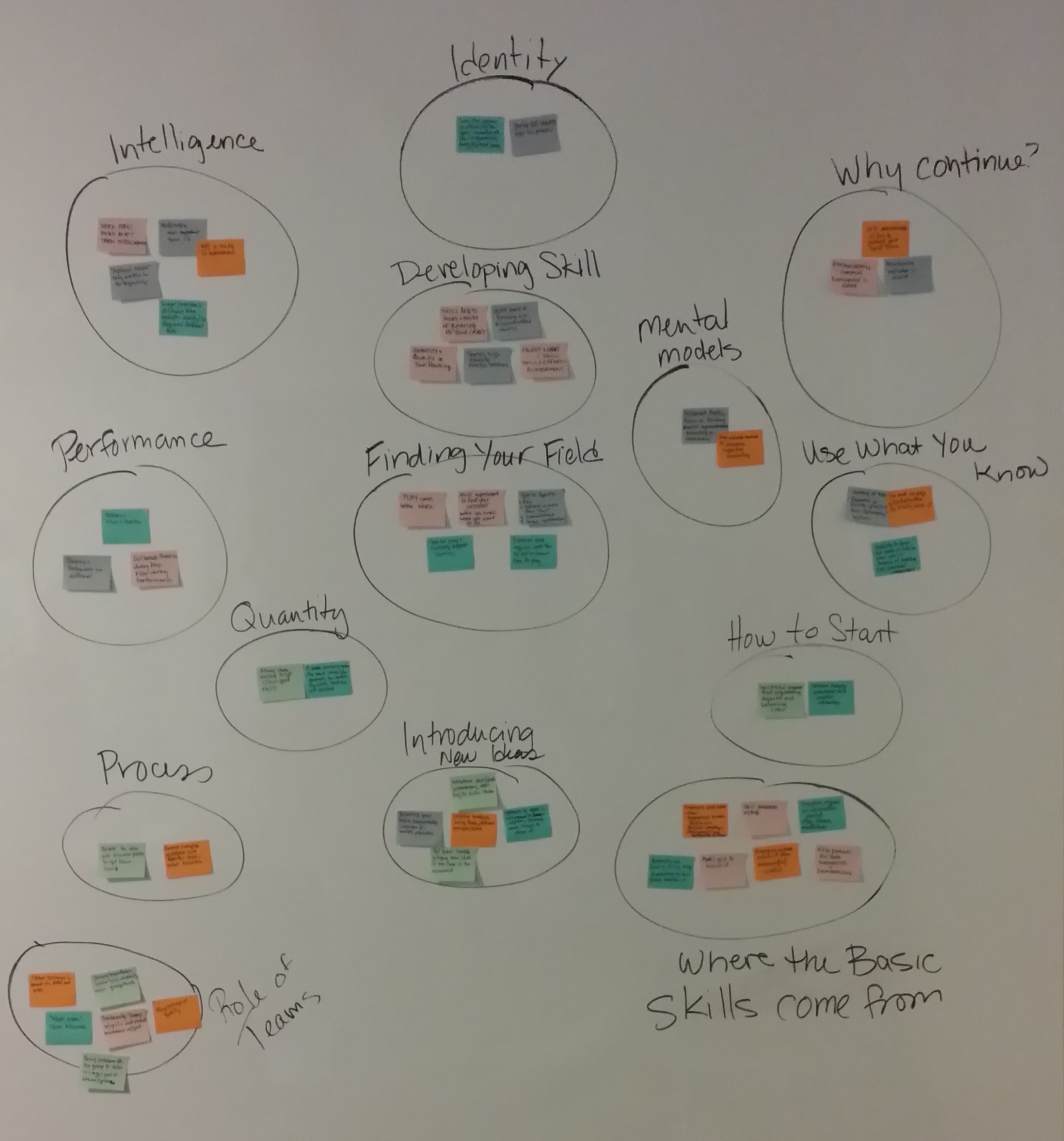 |  |
Well, honestly, not as much as I thought. The things that struck me as being related when I thought about the books abstractly were clearly NOT key topics of given chapters, so didn’t make it into the analysis. Perhaps if I’d tried to link them serially, I would have seen more, but just grouping wasn’t as dramatic as I expected.
But that doesn’t mean there weren’t trends.
First: Originals had the least overlap with the other four books. That doesn’t make the information better or worse, just different. Peak and Grit had the most overlap (Duckworth actually references Ericsson’s work, so that wasn’t too surprising).
Now, for the important part: the trends.
The only semi-conflicting information was on the value of commitment based organizations – those organizations that are very focused on taking care of its employees as one of its prime missions. On the one hand, they tend to be very stable, and last longer in environments like Silicon Valley, despite the fact that such values were deemed “dead” in the 1990s. On the other hand, they tend to attract like-minded people, leading to groupthink and too little ability to adapt. Dissension in the ranks can be good (as long as there is psychological safety, according to a third book).
While the trends aren’t as strong as I expected, I would say that, looking at the totality of the information in the books: training is important. (OK, that comes as no surprise to anyone who knows me.) But there is more to it, especially for the Army. Taking each trend above:
There is a lot of research being conducted in many different arenas related to the “Human Dimension”. And with the number of people in the Army organization – 1M in uniform, 330k civilian – it is, without a doubt, easier to focus on materiel development than on the human dimension. But the human element – fixing training, improving recruiting metrics, understanding why there are so many impulse control issues among returning soldiers, and so on – is significantly less expensive (means) and provides the Army a way to significantly increase the readiness (ends) in the near-term.
First, I need to acknowledge something: this whole “remembering to blog weekly thing” is harder (for me) than it should be. So, no more scheduling. Of any kind. Though I will (probably) go back in and fill in some holes. Especially about Peak, a book that is somewhat relevant to today’s post (at least in my mind), but I still haven’t managed to put together my thoughts in a sufficiently coherent manner, so I’m not ready to push “publish” on last week’s post quite yet.
For a number of reasons, this year, I haven’t been able to travel the way I have in years past. So instead, I’m going to events at various DC think tanks. It’s that, or I never leave my house. As an introvert, I’m pretty comfortable with that, but it’s not healthy, so… think tank events it is. Last week’s was “Army Readiness, Fight tonight and Fit for Tomorrow” at the Center for New American Studies. The speakers were Mr. Daniel Feehan, Principal Deputy Assistant Secretary of Defense (Readiness); MG Walter E. Piatt, Director of Operations, Readiness and Mobilization, Army G3/5/7; Mr. Andrew Hill, U.S. Army War College; and Ms. Katherine Kidder, Center for a New American Security.
Readiness is GEN Milley’s top priority and, as he says “there is no other number 1”. Readiness is the ability to defeat one peer competitor while holding back a second without losing ground in the war on terror. That’s a lot to expect from an Army that has 14 years of continuous asymmetric warfare under its belt; no full spectrum operations in that time (and very little training for it); and soldiers who are tired from the continuous cycle of deployments. rip
Readiness is usually seen as a tri-pod; manning, equipping, and training must balance for the organization to be ready. For the Army, manning levels are set by someone else. (Though there is a lot the Army can do to effect its manning by having the right people – recruitment and retention – that’s not today’s topic.) Equipping? Soldiers have a lot of good equipment – thanks to 14 years of warfare – and what they don’t have now, they won’t have any time soon, based on development timelines. (In fact, in February at New America’s Future of War Conference – I told you, I’m going to a lot of think tank events – GEN Milley said he doesn’t see any major new systems coming, just upgrades to legacy materiel, for the next 5-10 years.) So the key to improving readiness, it seems to me, is training.
Training systems – whether live, virtual, or constructive – are expensive and cumbersome. They all introduce various levels of non-realism. And all are limited, either by the number of people who can use them at once, by the echelon that is going to get priority, or by the terrain they cover. Many are ‘better than nothing’ – but often, the juice (cost and what it takes to make them work) isn’t worth the squeeze (the learning achieved). And our soldiers (and taxpayers) deserve better than this. And readiness demands it. Time at CTC, the premiere training event, has been shown to be more effective for organizations that have had more pre-CTC homestation training. So how do we get more out there?
Complaints about the current training systems are plentiful.
Live training (e.g., MILES)
Virtual training (e.g., DSTS)
Constructive training
None of these concerns are new or unknown to the Army. PEO STRI is working to field new systems, but the process is so slow that it will be 2025 before there is a new individual MILES system fielded, and 2028 before an integrated live, virtual, constructive, and gaming system is fielded.
But what about the next 10 years? What about readiness now? How do we increase full-spectrum operations training?
I’ve spent almost a decade working this issue. It can actually be resolved fairly easily, but there’s actually no path through the system for an easy training system. That being said, here are my observations:
Most organizations – governmental (PEO STRI and the USMC both have MILES issues, and both are looking at them the same way) and other companies – look at the issues with MILES as primarily an issue with the interrogator. If the laser could penetrate better, the system would work better. To that end, they’ve considered other wavelengths (1550 nm vs the current 908 nm), other technologies (e.g., geopairing), etc, for the next generation systems – and wind up back with the old system (partly because of backwards compatibility issues that STRI can’t seem to break free from).
When we first started designing TIS, the Training and Identification System, we didn’t focus on components. We looked at SYSTEM requirements. Because of that, we have a very different solution. Rather than fixing the issues at the interrogator end, we were free to look at the whole issue. And that’s what we did. By making one addition to the MILES communication code and adding a COTS smartphone (in place of any other kind of radio) on the target, we can resolve three of the four complaints about MILES. (Details to follow in a subsequent post – or contact me for details.)
But we didn’t stop there.
Because we know that the long-term goal is to incorporate live training with virtual, constructive, and gaming technologies, we wanted to make sure that TIS could do that. So we incorporated plans for alternative means of firing the laser (current MILES technology “fires” off the force of the blank leaving the barrel – this could be very dangerous in an LVCG environment where the shooter may be facing something or someone other than what he is seeing), designs for incorporating the shot into the virtual world, and so on – again, using a COTS smartphone as one of the major components.
Training can be modernized – training MUST BE modernized in a much shorter timeline – to improve readiness. Homestation training can be available without expensive instrumentation (that requires environmental assessments and approvals), to multiple groups, without need for a lot of extra space or people to run the systems. Guard units can actually make full use of their 48 Unit Training Assemblies and at 15 days of Annual Training rather than spending most of the time trying to get the gear to work (if they can use it at their armories at all).
Realistic, affordable, useable training systems in the hands of soldiers is the key to increasing readiness. But it requires a means other than the traditional process, or it will be late into the next decade before soldiers have it.
This week, New America hosted a forum entitled “The Future of War”. The speakers included the Service Chiefs from the Army, Marine Corps, and Navy, and the Air Force’s Vice Chief was on one of the panels. Add in panels representing academia, media, technology, and retired flag officers who aren’t afraid to speak their minds, and some short discussions about human enhancement and cyber (cyber rifle, anyone?), and it was an impressive, thought-provoking line up.
GEN Milley, in a conversation with Barbara Starr, talked a lot about acquisition and the (desperate, IMO,) need for acquisition reform. Many of his comments centered around the acquisition of a new pistol: a proven technology that is readily available at Cabelas. After many years, and hundred of pages (just in the requirements document – the rest of the documents would easily get the page count into the thousands, I’m sure), the top contenders are now undergoing a two-year, $16M test. To say the approach is slow would be an understatement, and GEN Milley does not even try to hide his frustration about that.
Presumably because the acquisition is so slow, and he knows what is in the pipeline, GEN Milley mentioned that he does not see any fundamental changes coming to the Army for the next 5-10 years. Beyond that, yes, but not in the next 5-10 years.
I have a number of concerns about this, as should anyone reading this. First, our primary adversaries (Russia and China) have not spent the past 15 years at war; while we have been depleting ours, they have spent that time beefing up their own arsenals.
But more importantly, to me, is that it assumes that fundamental change can only come through materiel. What about the human dimension? It is significantly faster and less expensive (though also significantly harder, due to necessary culture changes) to strengthen the human capital of the Army – the soldiers – both physically and mentally than it is to buy a new piece of gear.
Simply focusing on the Performance Triad in a meaningful way – making sure all soldiers get sufficient amounts and quality of sleep; good, healthy, nutritious food; and daily exercise – will increase readiness, reduce injuries, and increase performance. Eight solid hours of sleep at night. Eating right. Exercising daily – preferably in the afternoon, as that has been shown to increase the likelihood that soldiers will get the sleep they need in the morning. At no added cost to the Army. Going farther, there are techniques to improve training – physical and mental – thereby improving the capabilities of each soldier. Add in more physical monitoring – which many soldiers do on their own anyway – whether through a FitBit or any of the other commercial applications, and Army leadership can be proactive in maintaining the health and readiness of the force.
Near-term improvements – even fundamental changes – are possible, and will result in a stronger, more prepared Army. But they require changes to the Army’s culture.
On second thought, acquisition reform might be easier.
The first time I heard the phrase “cognitive overburden” was in 2011 or so, when Dr. Marilyn Freeman, then-DASA(R&T), introduced the 21 top Army S&T challenges. Because I was focused (perhaps hyper-focused) on my training system at the time, though I had never heard the phrase before, I instantly just “knew” that the answer to cognitive overburden was to train.
On and off for a few years, I would throw the phrase into my pitches, but it never really went anywhere. And I continued to know it was the answer without knowing (or, really, caring) why.
And then, one day, a well-meaning low level bureaucrat, upon listening to my pitch, looked at me and told me, with complete sincerity, that “the Army isn’t really interested in reducing cognitive load. We want to increase capacity. Do you have a way to make soldiers smarter?” I was a bit dumbfounded, but started researching and reading that day.
There really isn’t a lot written about cognitive load, certainly not using those terms. Mostly because it’s not something many people concern themselves with. Cognitive Load Theory is an educational design theory based on balancing intrinsic load (how difficult the material is) with extrinsic load (how the material is presented/designed) and germane load (effort expended by the student to understand). As a theory, it is boring and dry to read about, and complicated to implement.
There’s a lot of focus these days on UI (user interface) and UX (user experience) design, but these are both about maximizing enjoyment and increasing customer loyalty. Neither, even when used by educational companies, considers best education methods and balancing load.
Now, obviously, the Army does a lot of training, so cognitive load theory applies there. But does it apply anywhere else?
My contention is that it absolutely does. At the core of cognitive load theory is the understanding that learning is compromised when the sum of intrinsic, extraneous, and germane loads exceeds available working memory capacity. But it isn’t just learning that is compromised when working memory capacity (which I will address in detail at a later date) is exceeded; it’s all cognitive function. Everything a good soldier – a thinking soldier – does relies on cognitive function.
Given the amount of materiel all soldiers rely on to do their jobs, they are all, essentially, all systems-of-systems. And all of them can be overloaded, physically and mentally. Until all materiel solutions are designed with Cognitive Load Theory in mind, and an understanding that reducing extrinsic load of each one individually and of them all as a whole, soldiers will be in danger of shutting down mentally on the battlefield.
When we first started Analysis First, our focus was on a materiel training solution. After all, that’s where the money is. Also, when you have a fantastic idea, that will be the best thing the Army has ever seen, and soldiers will DEMAND to have in their kit, how could you not?
Well, let’s just say that was a long and expensive lesson in how the Army acquisition system does and does not work.
(And in case you think I’m exaggerating about the product’s usefulness, in one meeting with a uniformed S&T officer, my initial emails were compared with “those Nigerian email scams” because it was just too good to be true.)
In spite of the system never going anywhere, my passion for well trained soldiers continues. I’m not talking about the hours and hours of mandatory “You’re in the Army Now” training that everyone takes to check the box(es). I’m talking about actual job training: working towards an ability to dominate any adversary, whatever your job is.
I’m sure I will talk more about TIS in the future, but for today, I’ll just put out a few things that I think are vital to a new training system.
On Demand Training: Any organization should be able to train at any time, anywhwere. Yes, large scale operations take a lot planning, but a platoon leader should be able to make a decision to train and be able to implement quickly. Very few locations have homestation training available.
Scalable Training: Not only should any organization be able to train, but the same systems should be scalable. Training a squad and training a brigade should not look substantially different, insofar as the individual soldier and his tasks are concerned.
Easy to Use: It should not take a cadre of contractors to run and maintain the training systems. They should be intuitive to use, and easy to maintain.
And last, but certainly not least…
Realistic: We can’t replicate everything about war, but we certainly should come as close as we can. You can’t stop a bullet by covering yourself in dirt, so you shouldn’t be able to avoid being “injured” in training by doing so. “Train as you fight” has been a mantra for a long time. The technology exists. It’s time our soldiers had it.
© 2016, Analysis First LLC